
We do not publish a per-square-foot rate for apartment renovation in Downtown Dubai, and the reason is simpler here than anywhere else in the city: in a Downtown tower, the building sets more of your cost than your floor area does. Two identical layouts in two different buildings can run to different numbers because one has a service lift you can book for a full day and the other gives you four hours in the morning.
This page covers what actually moves the number in a Downtown apartment, what a complete quotation looks like, and how to compare two proposals that disagree. If you want a figure for your specific apartment, that comes from a survey and a specification, not from a rate card.
- Tower logistics are a genuine cost line, not an inconvenience. Service lift access, permitted hours, protection and waste routes all price into the job before a single tile is laid.
- Kitchens, bathrooms and bespoke joinery carry most of an apartment budget. Bedrooms and living areas carry surprisingly little.
- Downtown is an Emaar master community, so the paperwork usually starts with your building's Owners Association or managing agent before it reaches anyone else.
- The riser, the meter and the building services are not yours. That constrains what you can move and is worth establishing before the drawings are finished.
- Eight to fourteen weeks on site for a full apartment, with two to three weeks of design and selection before mobilisation.
Why the tower matters more than the square footage
Renovating a villa is a site operation. Renovating an apartment on the twentieth floor is a logistics operation that happens to involve building work. Everything comes up in a lift you have to book, everything goes down the same way, and every hour outside the permitted window is an hour nobody is working.
The practical cost drivers in a Downtown tower are:
- Service lift access. How many hours, on which days, at what notice, and whether there is a charge. A tower that gives you a full day is materially cheaper to work in than one that gives you a morning slot.
- Permitted working hours. Noise-heavy tasks are usually restricted, and the restrictions tighten on Fridays, public holidays and during Ramadan. That stretches the programme, and programme is cost.
- Protection. Lobbies, corridors, lift cars and common finishes have to be protected and reinstated. It is a real line item and it is where deposits get withheld.
- Waste removal. Some buildings mandate a specific contractor or specific windows. Strip-out waste from an apartment does not simply go into a skip on the street.
- Deliveries. Long lead items, stone slabs and joinery all have to arrive when the building allows, which means storing them somewhere or paying for a second delivery.
- The riser and the meter. In an apartment these belong to the building, not to you. A change that is trivial in a villa can need the Owners Association, the developer and DEWA to agree in sequence, which our DEWA guide covers in detail.
None of this is a reason to avoid renovating in a tower. It is a reason to have a contractor who has planned around it before, and to be suspicious of a quotation that carries almost nothing for preliminaries.
The four scope bands in an apartment
| Band | What is in scope | What usually is not |
|---|---|---|
| Refresh | Paint, flooring, lighting, sanitaryware swapped in position | Anything behind a wall, layout changes, MEP |
| Standard | New kitchen and bathrooms in existing positions, new wardrobes, full finishes | Moving wet areas, altering the layout |
| Premium | Layout changes, relocated wet areas where the building allows, bespoke joinery throughout, stone, upgraded MEP | Anything touching the structure or the facade |
| Full | Complete strip-out and rebuild of the interior, integrated AV and lighting control, full joinery package | Loose furniture unless specified, external and facade works |
The band that catches people in towers is premium, because moving a wet area in an apartment is not simply a drainage question. It depends on where the riser is, what the slab allows, and what the building will approve. Establish that before the design is signed off rather than after. Our apartment renovation service starts with that check.
Where the money actually goes
Apartment budgets concentrate harder than villa budgets. The kitchen and the bathrooms carry the plumbing, the waterproofing, the stone, the appliances and most of the joinery, and they are typically a small fraction of the floor area. Bedrooms and living areas carry paint, flooring, lighting and wardrobes, and cost far less per square foot than the average implies. This is the whole reason a rate per square foot is misleading: a two-bedroom apartment with three bathrooms and a large kitchen is a different project from a three-bedroom with one bathroom and a galley.
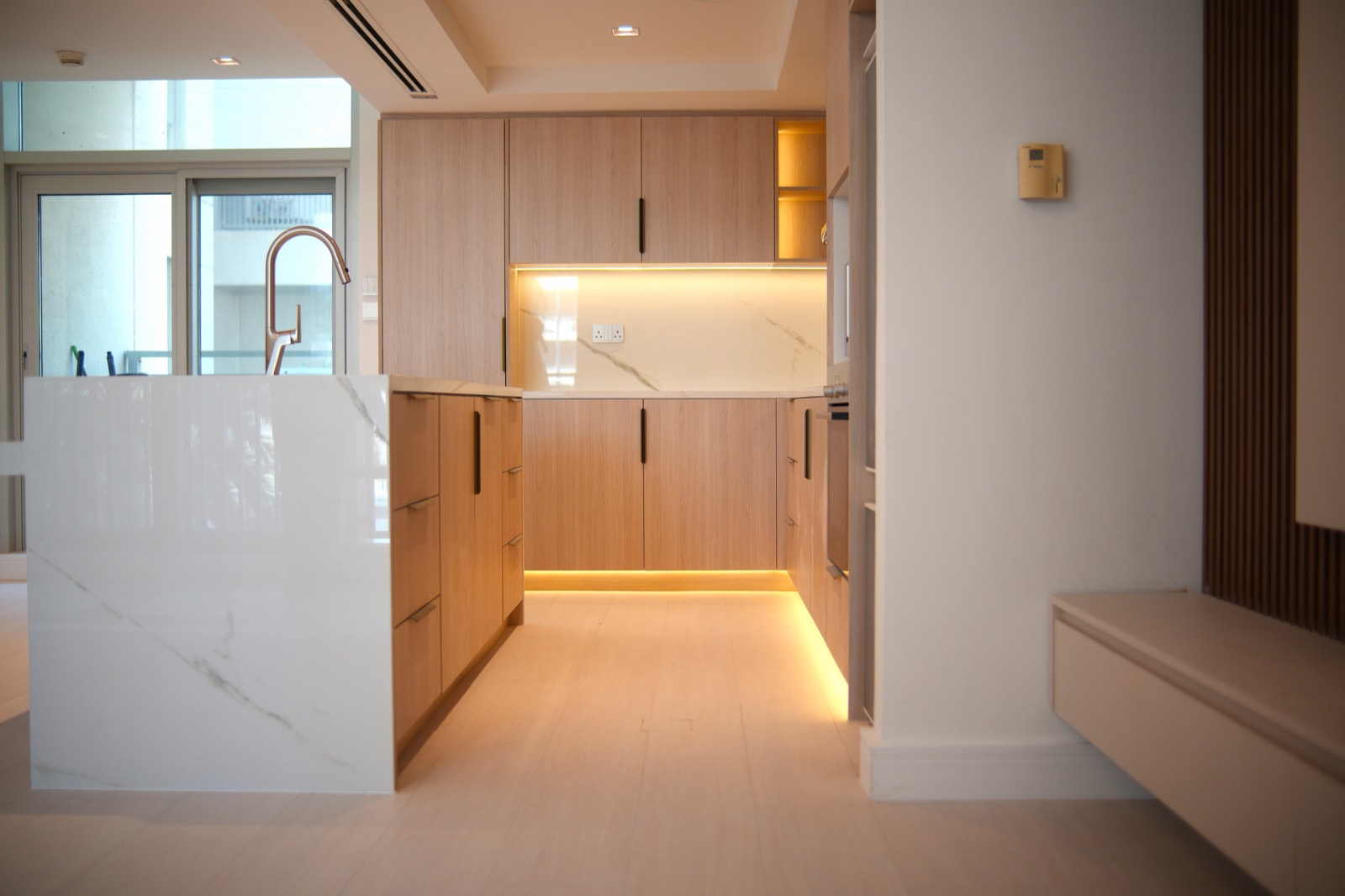
After the wet areas, bespoke joinery is usually the largest single trade. In our apartment at The Lofts, the waterfall stone island, the integrated appliances, the walk-in wardrobe and the backlit shelving are the elements that define the space, and they are also where the budget sits. We make joinery in our own Dubai workshop, which is a lead-time decision as much as a cost one when everything has to be lifted twenty floors in a booked slot.
Approvals, and who pays for them
Downtown Dubai is an Emaar master community, so the file usually starts with your building's Owners Association or managing agent and the developer NOC. An authority permit follows where the work is structural, changes the layout of wet areas or alters services, and a DEWA clearance follows where the electrical load or the metering changes. Our Emaar NOC guide and the broader approvals overview set out the sequence.
The costs attached to this are real even when they are refundable. Expect a security deposit held by the building, worker pass charges, service lift booking fees in some towers, and authority and utility fees where those layers apply. Ask any contractor plainly whether these sit inside their price or are payable by you to third parties, because both answers are legitimate and only one of them is what you assumed. We prepare and submit developer NOCs, authority permits and utility clearances as part of project management.
What a complete quotation contains
- A room-by-room scope rather than a lump sum.
- A specification naming brands, models, finishes and sizes, or a stated provisional sum where a selection is open.
- Joinery broken out separately, with a note on where it is manufactured.
- MEP as its own section, stating whether existing capacity was surveyed or assumed.
- A preliminaries section covering protection, lift bookings, waste removal, permits and site supervision. In a tower this is not padding.
- Who lodges the OA and developer NOC, the authority permit and the DEWA clearance, and whose fees they are.
- A programme showing the sequence, the long lead items and the dependencies.
- A written exclusions list.
- Warranty terms with durations.
The exclusions that cause the arguments
- Making good after the strip-out, once what is behind the old kitchen is visible.
- MEP work priced as an allowance rather than surveyed.
- Building deposits, pass fees and lift charges.
- Waste removal, particularly where the building mandates a contractor.
- Protection and reinstatement of common areas.
- Appliances, sanitaryware and loose furniture listed as client-supplied.
- Stone wastage on book-matched or large-format slabs.
- Snagging and the return visit after handover.
Ask for the exclusions in writing before comparing prices. In apartments it reorders the shortlist more often than the prices do.
Timeline, and why it is part of the cost
A full Downtown apartment runs eight to fourteen weeks on site, with design and material selection running in parallel and adding two to three weeks before mobilisation. A single kitchen or a pair of bathrooms on their own is four to eight weeks, usually paced by stone fabrication rather than by the building work. If you are renting elsewhere while the work runs, every week of overrun is a cost that never appears on an invoice, which is the argument for a complete drawing set and confirmed selections before anyone mobilises. Our renovation timeline guide shows where the weeks go.
Why two quotations disagree
When two Downtown proposals come back far apart, the gap is usually scope rather than margin. One priced what you asked for and the other priced what the apartment needs. One surveyed the MEP and the other assumed it. One carried a realistic preliminaries figure for lift bookings, protection and restricted hours, and the other carried close to nothing, which is the single most common way a tower quotation ends up looking cheap. One included approvals and the other left them with you. One manufactures joinery and the other buys it in.
Normalise the scopes before you compare totals: take the most detailed proposal, send its scope to the other bidders, and ask them to re-price against it. Our guide to choosing a fit-out contractor covers what good answers sound like, and our comparison of Dubai renovation companies covers who you are choosing between.
How to get a number you can rely on
Send us the floor plan, the building, and what you want to change. We will tell you what the tower will allow, which scope band you are actually in, and what we need in order to price it against a written specification. We work across Downtown Dubai, with published work at The Lofts and experience in the surrounding Emaar towers, and our Downtown Dubai page sets out how we run projects in occupied buildings.
Book a consultation and we will give you a real number rather than an average.
Frequently asked
How much does it cost to renovate an apartment in Downtown Dubai?
It depends far more on the number of wet areas, the joinery package and the building's own rules than on the floor area. A two-bedroom with three bathrooms and a large kitchen is a different project from a three-bedroom with one bathroom. The only figure worth acting on comes from a survey and a written specification with the exclusions listed, which is why we do not publish a rate.
Is renovating an apartment cheaper than renovating a villa?
Usually smaller in total, but not necessarily cheaper per square foot, and sometimes the opposite. An apartment has no external works, no pool and no landscaping, which removes whole categories of cost. Against that, tower logistics add real expense: booked service lifts, restricted working hours, protection of common areas and controlled waste routes all price into the job.
Can I move a kitchen or bathroom in a Downtown Dubai tower?
Sometimes, and it depends on where the riser sits, what the slab allows and what the building will approve, rather than on what the drawing shows. Establish it before the design is signed off, because it is the difference between a standard scope and a premium one. Relocating a wet area will normally need the Owners Association, the developer and DEWA to agree, and often an authority permit as well.
Do I need an NOC to renovate an apartment in Downtown Dubai?
In almost every case, yes. Downtown Dubai is an Emaar master community, so the file usually starts with your building's Owners Association or managing agent and the developer NOC. An authority permit follows where the work is structural, changes the layout of wet areas or alters services, and DEWA clearance follows where the electrical load or metering changes. We prepare and submit all of it as part of project management.
How long does a Downtown apartment renovation take?
Eight to fourteen weeks on site for a full apartment. Design and material selection run in parallel and add two to three weeks before site mobilisation. A single kitchen or a pair of bathrooms on their own is four to eight weeks, usually paced by stone fabrication rather than by the building work.
Why is the preliminaries figure so high on a tower quotation?
Because in an apartment the logistics are a real part of the job. Service lift bookings, protection and reinstatement of lobbies and corridors, controlled waste routes, deliveries inside permitted windows and site supervision across restricted hours all cost money before any building work happens. A tower quotation carrying almost nothing for preliminaries is usually not cheaper, it is just incomplete.